Molecular Simulation and Analysis of Ionic Polyimide Membranes in Ionic Liquid Solvents
Project Overview
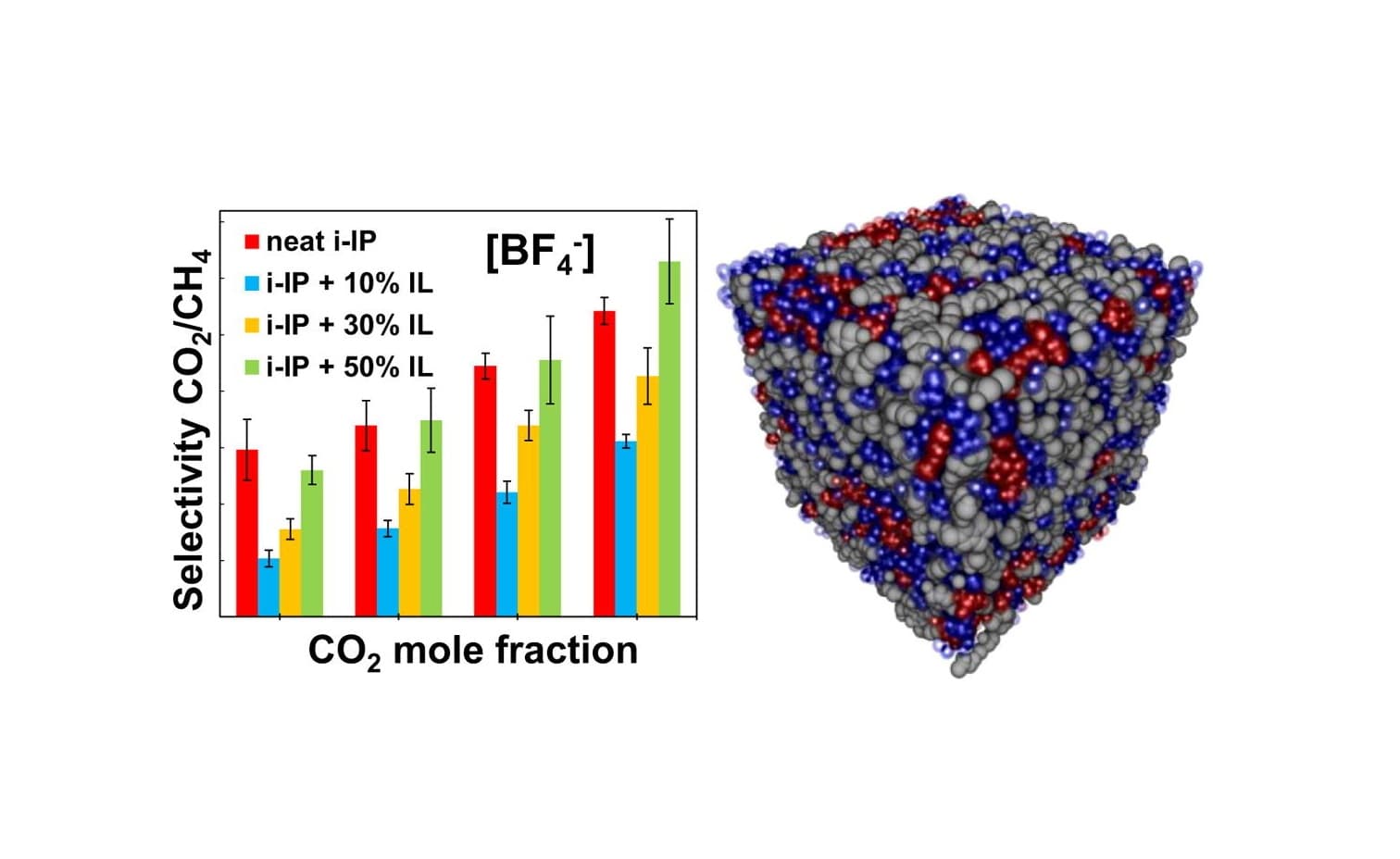
This collection of papers as a project explores the use of ionic polyimides (i-PIs) as advanced materials for CO2 capture and gas separation, leveraging molecular dynamics (MD) and grand canonical Monte Carlo (GCMC) simulations to understand and optimize their adsorption and diffusion properties. The addition of imidazolium-based ionic liquids (ILs) greatly enhances gas separation performance by lowering the i-PI glass transition temperature (Tg), improving CO2 solubility, and creating favorable transport pathways at higher IL concentrations. Investigations into various IL anions, such as [Tf2N−], [PF6−], [BF4−], [oAc−], and [C(CN)3−], reveal their distinct effects on adsorption properties, solubility, and diffusivity, with [C(CN)3−]-based systems showing particularly improved CO2 diffusion. Surface area, fractional free volume, and polymer relaxation were revealed as critical structural factors linked to adsorption behavior, while IL inclusion significantly alters molecular-level interactions, enhancing selectivity for CO2 over CH4 and N2. This comprehensive study provides valuable insights into designing and optimizing i-PIs and i-PI + IL composites for high-performance gas separation membranes.
The articles that comprise this work are shortly and informally described below. Please give some of them a further read if the summaries interest you.
Molecular Simulation of Ionic Polyimides and Composites with Ionic Liquids as Gas-Separation Membranes
This study investigates CO2 and CH4 adsorption in ionic polyimides (i-PIs) and i-PI + ionic liquid (IL) composites using molecular dynamics (MD) and grand canonical Monte Carlo (GCMC) simulations. Results reveal that surface area plays a critical role in gas solubility during polymer relaxation and that the presence of IL alters molecular adsorption sites, improving selectivity in gas purification processes.
View details and external link to paper
Molecular analysis of selective gas adsorption within composites of ionic polyimides and ionic liquids as gas separation membranes
The second work of this project models the CO2 separation performance of ionic polyimides (i-PIs) and their composites with various ionic liquids (ILs) using molecular dynamics and Monte Carlo simulations. Results show that IL inclusion enhances gas selectivity, with [PF6−]-based composites improving CO2/CH4 selectivity by 36%, while [Tf2N−]-based systems exhibit higher CO2/N2 selectivity, driven by differences in structural properties like fractional free volume and surface area.
View details and external link to paper
Molecular Transport Behavior of CO2 in Ionic Polyimides and Ionic Liquid Composite Membrane Materials
This third publication combines Monte Carlo and molecular dynamics simulations to explore the equilibrium and transport properties of CO2 in ionic polyimides (i-PIs) and i-PI + ionic liquid (IL) composites, revealing that IL addition lowers the glass transition temperature (Tg) of i-PIs, enhancing CO2 solubility. While low IL concentrations hinder diffusion via a blocking effect, higher IL concentrations facilitate transport by increasing polymer plasticization and creating favorable pathways for CO2 movement.
View details and external link to paper
Solubility and diffusivity of CO2 in ionic polyimides with [C(CN)3]x[oAc]1−x anion composition
This study uses molecular dynamics and Monte Carlo simulations to investigate the adsorption and diffusion properties of CO2 in ionic polyimides (i-PIs) with acetate ([oAc−]) and tricyanomethanide ([C(CN)3−]) anions, revealing that higher [C(CN)3−] concentrations enhance CO2 diffusion while maintaining solubility. Structural analyses show diffusivity correlates moderately with fractional free volume (FFV), providing insight into how anion composition impacts performance in i-PI gas separation membranes, distinct from pure ionic liquid behavior.