Molecular analysis of selective gas adsorption within composites of ionic polyimides and ionic liquids as gas separation membranes
Chemical Physics
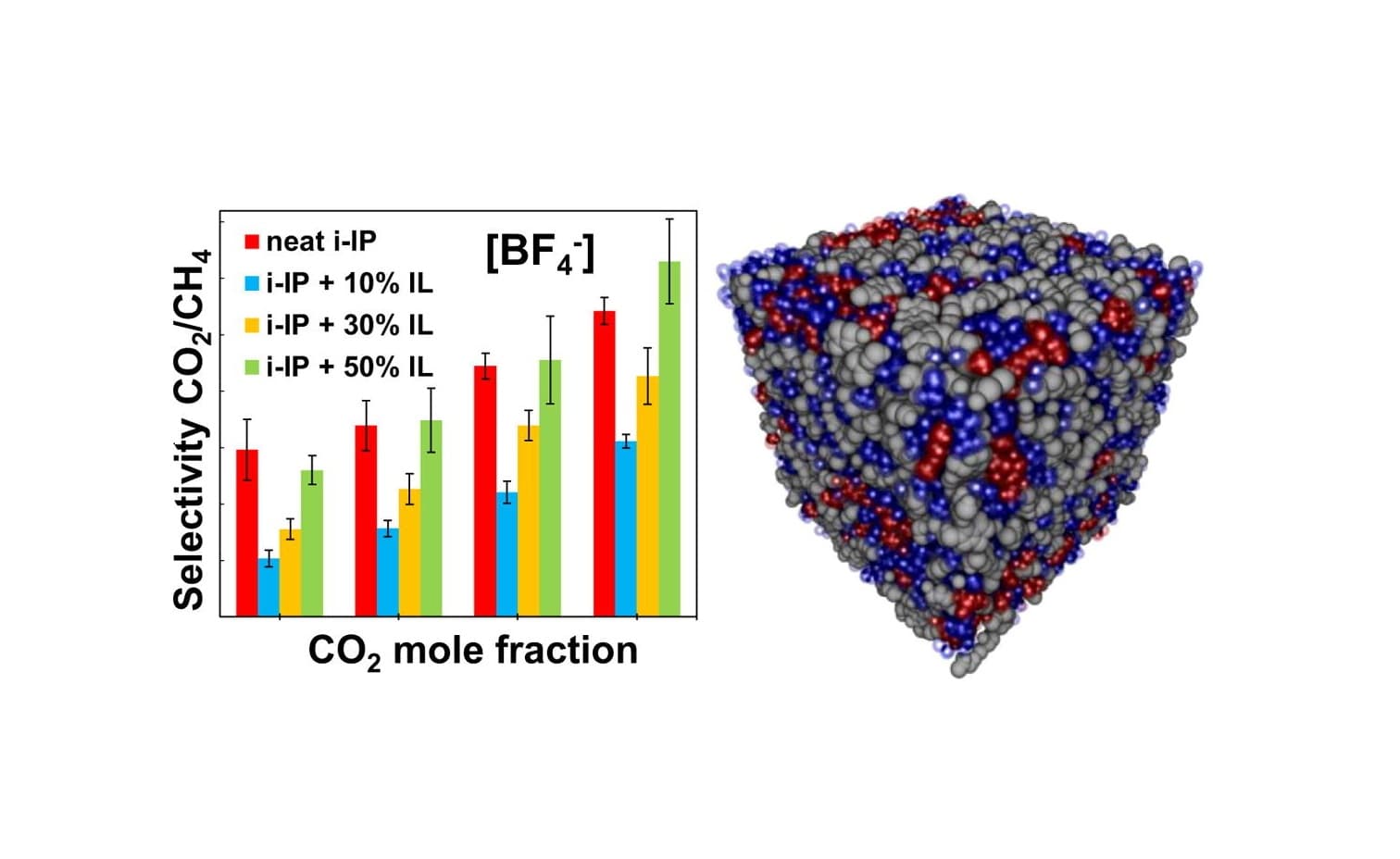
Molecular analysis of selective gas adsorption within composites of ionic polyimides and ionic liquids as gas separation membranes
Research Summary
The CO2 separation characteristics of ionic polyimides (i-PIs) are modeled using molecular dynamics simulations in combination with grand canonical Monte Carlo calculations. The performance of neat i-PI systems is evaluated, as well as composite structures containing both i-PIs and various ionic liquids (ILs). The i-PI + IL composites are based on combinations of 1-n-butyl-3-methylimidazolium ([C4mim+]) cations with three common molecular anions: (bis(trifluoromethylsulfonyl)imide ([Tf2N−]), tetrafluoroborate ([BF4−]), and hexafluorophosphate ([PF6−]). It is found that 50 mol% IL inclusion can increase CO2/CH4 selectivity by 16% in [BF4−]-based materials and by 36% in [PF6−]-based materials from mixtures of 5% CO2/95% CH4. While the [BF4−]-based system shows higher CO2/CH4 selectivity, the [Tf2N−]-based system shows higher CO2/N2 gas selectivity. A comprehensive structural analysis (fractional free volume (FFV), pore size distribution, surface area, etc.) is used to highlight the underlying differences among the different i-PI + IL systems that lead to the different adsorption properties.