Inverse Design of Alloys via Generative Algorithms: Optimization and Diffusion within Learned Latent Space
Advanced Intelligent Discovery
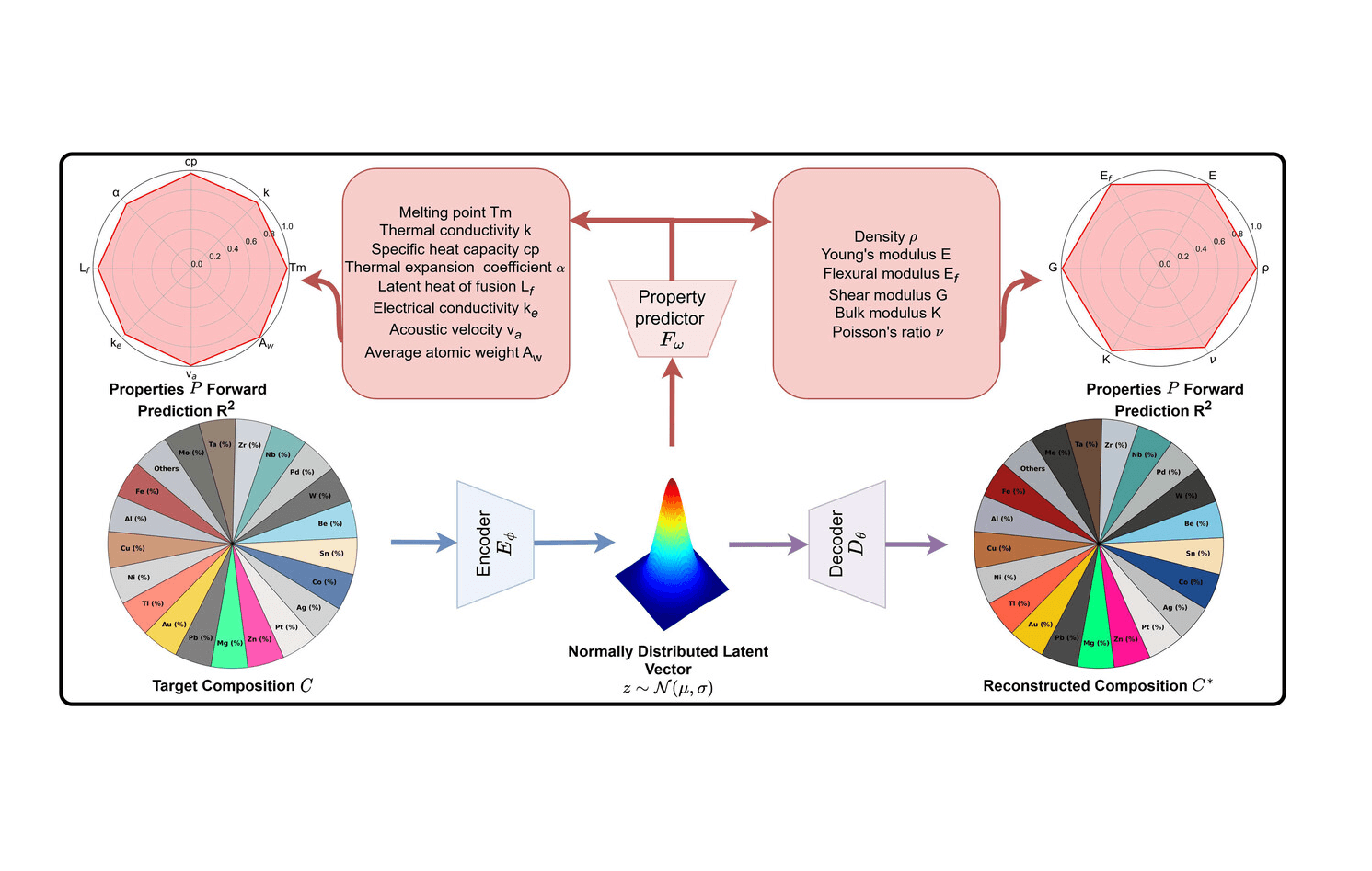
Inverse Design of Alloys via Generative Algorithms: Optimization and Diffusion within Learned Latent Space
Research Summary
Inverse design—generating material compositions that exhibit target properties—presents a promising avenue for accelerating novel material discovery. Artificial intelligence (AI) has emerged as a powerful tool for inverse learning. However, several challenges exist in developing AI tools for the inverse generation of novel alloys: limited availability of training data; nonuniqueness of solutions, where multiple compositions yield the same properties; and the complexity of navigating high-dimensional design space. This work proposes a novel generative AI framework that addresses these challenges by integrating a variational autoencoder (VAE) with two inverse design approaches: latent gradient optimization and latent diffusion model. The VAE establishes a compact low-dimensional latent space that enables smooth composition–property mapping, while both inverse methods generate compositions that match target properties. The optimization approach iteratively refines latent representations to search for optimal design, whereas the diffusion model progressively denoises latent variables to generate diverse and valid compositions. Both methods successfully generate alloy compositions with targeted properties, while the diffusion model outperforms in distribution-level reconstruction when both models are tested under the same conditions. Trained and validated on the Granta Alloys dataset, the proposed inverse generative framework provides a robust and scalable approach for discovering novel alloy composites and generating multiple feasible solutions.