Generative Learning of Densities on Manifolds
Computer Methods in Applied Mechanics and Engineering
Generative Learning of Densities on Manifolds
Research Summary
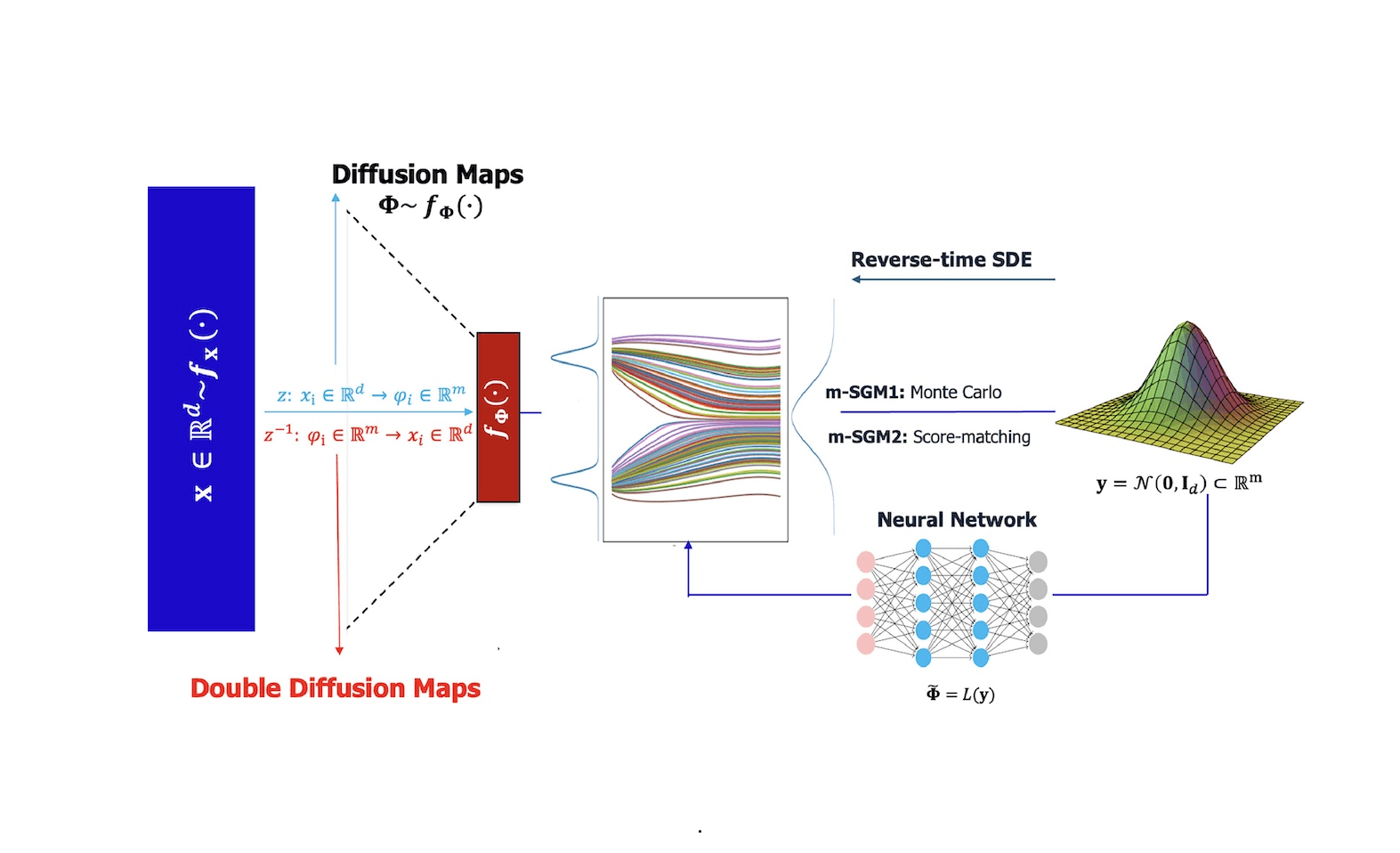
This study introduces and validates a framework for generating data distributions on high-dimensional manifolds using modified score-based generative models (m-SGMs). The model leverages nonlinear dimensionality reduction methods to address challenges in high-dimensional uncertainty quantification. Applications in computational mechanics demonstrate the robustness and efficiency of the proposed approach over conventional methods.
Motivation
High-dimensional data encountered in multiscale computational mechanics, like stress-strain relationships in complex materials, presents challenges for accurate and efficient modeling. The framework developed in this paper aims to address:
- The curse of dimensionality in simulations and sampling strategies.
- Generative modeling of data constrained to manifolds defined by experimental and synthetic results.
- Incorporation of physics-based features in generative approaches to ensure consistency with observed phenomena.
By employing manifold learning and score-based techniques, the paper seeks to improve the fidelity of synthetic data generation and its applicability to real-world computational mechanics problems.
Methodology
Framework Details
-
Modified Score-Based Generative Models (m-SGMs):
- Adapt score-based algorithms to directly model multiscale material systems.
- Integrate physics-based parameters to maintain correspondence with real data.
-
Double Diffusion Maps:
- Utilize these as a dimensionality reduction tool to parameterize manifolds, facilitating sampling in high-dimensional spaces.
-
KL Divergence Performance Metrics:
- Statistical comparison of the generated distributions against ground truth to quantify model precision.
Dataset Used
- 800-point simulation comparing tensile and bending test outcomes, structured into 449 feature dimensions.
- Dimensions include microscale, mesoscale, and macroscale properties.
Techniques Applied
To generate additional realizations for high-dimensional synthetic datasets, the framework employs m-SGMs combined with double diffusion maps, surpassing typical generation techniques in efficiency and quality.
Results
Applications
-
Synthetic Stress-Strain Data:
- Generated distributions accurately mimic observed stress-strain curves from laboratory tests.
- Validated results include accurate reproductions under bending and tensile configurations.
-
Dimensionality Reduction:
- Experimental data constrained within manifolds showed strong agreement with real-world outcomes.
- Double diffusion maps provided significant enhancements to sampling precision.
-
Performance Analysis:
- Among methods evaluated, m-SGM1 produced the lowest KL divergence, indicating the highest fidelity to true data distributions.
Computational Metrics
- Improved runtime performance relative to standard Monte Carlo Simulations (MCS).
- Increased sampling precision across multiscale dimensional embeddings.
Key Insights
- Generative Modeling vs. MCS:
- Modified approaches reduce computational complexity while improving fidelity.
- Physics-Based Integration:
- Ensures synthetic data aligns with physical constraints of observed phenomena.
- Scalability:
- Applicability expands to larger, complex datasets by leveraging manifold-parametrization techniques.
Future Work
- Expanding to stochastic dynamics and chaotic systems.
- Improving framework scalability for higher-dimensional contexts.
- Creating publicly accessible benchmarks for generative models designed for physical systems modeling.