Generative Learning for Slow Manifolds and Bifurcation Diagrams
Computers and Chemical Engineering
Generative Learning for Slow Manifolds and Bifurcation Diagrams
Research Summary
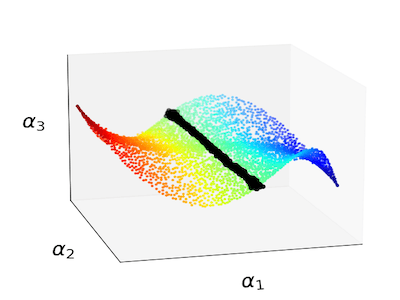
This paper proposes a framework leveraging conditional score-based generative models (cSGMs) and nonlinear dimensionality reduction techniques to efficiently approximate slow manifolds and construct bifurcation diagrams in multiscale dynamical systems. The approach circumvents fast transient dynamics and identifies steady states by directly initializing on the low-dimensional slow manifold of a system.
Motivation
In systems characterized by multiple time scales, slow manifolds capture the long-term dynamics and are crucial for model reduction. Approximating these manifolds accurately improves the efficiency of dynamical simulations. Traditional numerical methods for identifying steady states or bifurcation points in such systems often require significant computational resources.
By using cSGMs conditioned on quantities of interest (QoIs), the proposed framework generates samples directly on the slow manifold, enabling faster and more precise model initialization. Additionally, the framework addresses challenges in filling missing segments of bifurcation diagrams and reduces computational effort in identifying steady states.
Methodology
Conditional Score-Based Generative Models (cSGMs)
- Trained cSGMs to generate consistent data samples conditioned on QoIs, which represent desired labels on the slow manifold or bifurcation surfaces.
- Utilized these samples to approximate slow-manifold geometries and steady-state distributions in dynamical systems.
Diffusion Maps and Manifold Learning
- Implemented nonlinear dimensionality reduction via diffusion maps to reduce stochasticity and improve sampling in deterministic dynamical systems.
- Applied this method to identify QoIs that parameterize the slow manifold from system data.
Framework for Initialization and Steady-State Identification
- Combined cSGMs and diffusion map outputs to initialize simulations directly on the slow manifold, bypassing transient state exploration.
- Demonstrated the framework's efficiency in constructing steady-state solutions and bifurcation diagrams under varying parameters.
Results
Applications and Validation
-
Steady-State Identification:
- Efficiently approximated steady states in bifurcation diagrams for out-of-sample parameter values.
- Reduced computational overhead compared to traditional initialization approaches.
-
Bifurcation Analysis:
- Identified bifurcation points and geometric properties of reduced manifolds with high precision.
-
Extrapolation Performance:
- Demonstrated scalability and generalization capabilities in dynamic systems with large parameter spaces.
-
Application Examples:
- Validated the framework using a reaction–diffusion partial differential equation (PDE).
- Explored its utility in a plug-flow tubular reactor system, highlighting improved initialization over classical numerical methods.
Computational Efficiency
- Sidestepped transient phases in dynamical simulations, achieving significant reductions in simulation time after the model training phase.
- Enhanced phase space exploration through integration with physics-based simulations.
Key Insights
- Multiscale Advantages: Facilitates switching between fine-scale and reduced-order coarse-scale simulations without needing extensive transient stabilization.
- Manifold Parameterization: Demonstrated the efficacy of combining data-driven and physics-based approaches in identifying low-dimensional embeddings.
- Versatility: Broad applicability to systems governed by ODEs and PDEs with separation of timescales.
- Extrapolation Robustness: Effectively fills in missing segments of bifurcation diagrams and handles parameter extrapolation.
Future Work
- Extending the integration of cSGMs with other manifold learning techniques.
- Enhancing scalability for applications in high-dimensional systems.
- Exploring additional stochastic and chaotic dynamical systems.
Dataset and Code: Available at https://github.com/ecrab/generative_learning_slow_manifolds